Shopping · Amazon

Amazon Price Tracker & Price History API
The Amazon Price Tracker & Price History API gets you live Amazon data the moment you ask, as clean, structured data – ready for your own app, a spreadsheet or an AI assistant. No scraping, nothing to maintain.
100 free requests every month · no credit card · one API key for all platforms
Key facts
Updated
An Amazon price tracker has to answer two questions reliably, thousands of times a day: what does this ASIN cost right now, and what does its Amazon price history look like over the past weeks? everydata.io answers both with plain HTTPS calls, so you can build your own tracker instead of maintaining a scraper. A product lookup returns the live buy-box price, the crossed-out list price, shipping cost and stock status straight from the product page; the price-history endpoint returns the observations we have already collected for that ASIN, so you do not have to store every poll yourself.
- Platform
- Amazon
- Main endpoint
- /amazon-lookup-product-by-asin
- Quota per call
- 1 request
- Free plan
- 100 req / monththen from €30 / month
What the Amazon Price Tracker & Price History API returns
Every price call hits the live Amazon page at the moment you request it. There is no shared catalogue in between that could hand you a price from yesterday. If you monitor a product on amazon.de and amazon.com, you make two calls with two domainCodes and get the localised price, currency and shipping message for each marketplace.
The payload is deliberately flat. price and retailPrice are numbers (not "$12.99" strings), currency is an ISO code, warehouseAvailability is the human-readable stock line and soldBy / fulfilledBy tell you whether the buy box is currently held by Amazon or a third-party seller – the single most common reason a price suddenly changes.
That is all a price tracker needs. Poll the products on your watch list, compare each new price with the last one, and you have price tracking for price drops, price changes and back-in-stock events. The history endpoint adds the trend, so you can see whether today's price is really the best price of the past weeks.
- Live price, retailPrice (list price), shippingPrice and currency as numeric fields
- Buy-box owner (soldBy) and fulfilment channel (fulfilledBy) to explain price jumps
- Stock status and delivery message (warehouseAvailability, deliveryMessage)
- Variation-aware lookups: append ?psc=1 or use the exact child ASIN to track one size or colour
- Price history endpoint with observedAt, price, currency, seller and inStock per observation, plus minPrice and maxPrice
- All Amazon marketplaces via domainCode: com, de, co.uk, fr, it, es, ca, com.mx, com.br, nl, se, in, co.jp, com.au, ae
What teams build with the Amazon Price Tracker & Price History API
Consumer price-drop alerts
Store the last seen price per ASIN and marketplace, poll on a schedule and notify users when price falls below their target. Include soldBy in the alert so users understand a 3rd-party price.
Repricing for marketplace sellers
Compare your own offer with the buy-box price and the full offer list, then adjust in your seller tool. Realtime data matters here – a stale price means an unprofitable undercut.
MAP and brand-price compliance
Brands watch their catalogue across amazon.com, .de, .co.uk and .fr for prices below the minimum advertised price and collect the seller name as evidence.
Price history charts
Plot the history array (observedAt, price) as a line chart next to the live price; seller shows when the buy box changed hands. Shoppers see at a glance whether a deal is a real price drop or the usual price.
Your own price tracker app
Browser extensions and price tracker sites track for one shopper. With the API you run the tracker for your own users, products and marketplaces, and send alerts by e-mail, Slack or push.
Historical price analytics
Combine the price-history endpoint with your own observations to compute average, min and max over 30/90 days and detect fake discounts before Prime Day or Black Friday.
Amazon Price Tracker & Price History API: example request and response
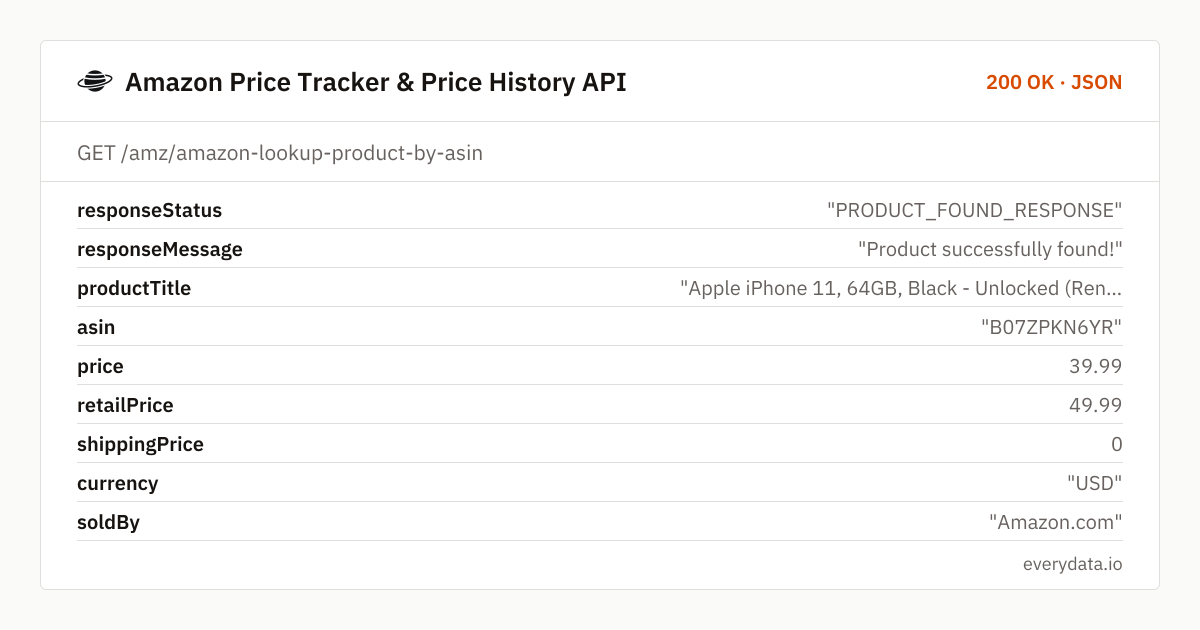
Use GET /amz/amazon-lookup-product-by-asin when you already know the ASIN and marketplace – that is the typical shape of a tracker's watch list. The URL-based sibling /amz/amazon-lookup-product accepts any product URL you copy from a browser. Both return the same fields.
GET /amz/amazon-lookup-product-by-asin
curl "https://api.everydata.io/amz/amazon-lookup-product-by-asin?asin=B07ZPKN6YR&domainCode=com" \
  -H "x-api-key: YOUR_API_KEY"
Response (shortened)
{
  "responseStatus": "PRODUCT_FOUND_RESPONSE",
  "responseMessage": "Product successfully found!",
  "productTitle": "Apple iPhone 11, 64GB, Black - Unlocked (Renewed)",
  "asin": "B07ZPKN6YR",
  "price": 39.99,
  "retailPrice": 49.99,
  "shippingPrice": 0,
  "currency": "USD",
  "soldBy": "Amazon.com",
  "fulfilledBy": "Amazon",
  "warehouseAvailability": "In Stock",
  "productRating": "4.2 out of 5 stars",
  "countReview": 60024
}
For the trend line, call GET /amz/amazon-price-history?asin=B07ZPKN6YR&domainCode=com&days=90. It returns count, minPrice, maxPrice and a history array of {price, currency, seller, inStock, observedAt} entries – the observations everydata.io recorded for that ASIN and marketplace. The more often an ASIN is looked up (by you or any other customer), the denser its history.
Two practical notes: a price of 0 together with a warehouseAvailability message means Amazon showed no buy box for that request (out of stock or not shippable to the default location) – treat it as "no offer", not as free. And if you only care about the cheapest offer rather than the buy box, GET /amz/amazon-lookup-prices lists every seller offer for the ASIN with condition and shipping.
Polling frequency is up to you. Most trackers refresh fast-moving electronics every few hours and long-tail items daily. Add cacheTtl=3600 on the product lookup if a one-hour-old price is acceptable – cached responses are faster and are flagged in your usage statistics.
Related endpoints
Product details by ASIN. Same payload as product details, addressed by ASIN and marketplace.
Product details. Full product page by URL: title, price, rating, images, features, variations, reviews.
Price history. Prices this API observed in your lookups over the last 1 to 730 days, with lowest and highest price. Call the lookup first. Full history on paid plans, last 5 entries on Free.
Seller offers. All offers for an ASIN including buy box, condition and shipping.
Amazon Price Tracker & Price History API pricing: pay per request
Each product lookup and each history call counts as one request against your monthly quota, whatever the marketplace. The free plan includes 100 requests a month – enough to prototype a watch list – and the Starter plan (5,000 requests, €30) covers a small tracker polling ~160 ASINs daily. Failed upstream fetches are never billed.
- Free
- 100 req / month
- Starter
- 5,000 req · €30
- Production
- 50,000 req · €80
- Business
- 300,000 req · €300
Build it step by step
Let an LLM look up live Amazon prices while it answers: two Python tools, one JSON Schema and working loops for OpenAI- and Anthropic-style tool calling.
Python · AmazonA small Python script that checks Amazon prices every day, saves them to a CSV file and tells you when a product drops below your target price.
Python · AmazonScrape Amazon with Python: search results with price, rating and sales volume, then full product data per ASIN – saved to CSV, no HTML parsing or proxies.
Amazon Price Tracker & Price History API: frequently asked questions
How do I set up Amazon price drop alerts?
Store the target price per ASIN. Poll the product on a schedule with the by-ASIN endpoint. When price is below the target and warehouseAvailability shows stock, send the alert. Include soldBy, so the user knows whether Amazon or a third-party seller offers the price.
How is this different from Keepa, camelcamelcamel or a browser extension?
Price tracker sites and browser extensions are made for shoppers: they show a price history chart and send price drop alerts. Keepa's API serves price history from Keepa's own database. everydata.io fetches the live Amazon page on every request and adds the history it has recorded, so you build the tracker yourself – for your users, in your app.
Can I find the best price across all sellers?
Yes. The product lookup returns the buy-box price. GET /amz/amazon-lookup-prices lists every seller offer for the ASIN with price, condition and shipping, so you can pick the lowest total price.
How often can I poll a price?
As often as your rate limit allows – 10 requests per minute on the free plan, up to 250 per minute on Business. Amazon prices for most items change a few times a day at most, so hourly or daily polling is typical.
Does the API return the buy-box price or the lowest price?
The product lookup returns the buy-box price shown on the product page, plus soldBy and fulfilledBy. For the lowest price across all sellers use the offer-listing endpoint /amz/amazon-lookup-prices, which lists every offer with condition and shipping.
Which Amazon marketplaces are supported?
Pass the TLD as domainCode: com, ca, com.mx, com.br, co.uk, de, fr, it, es, nl, se, in, co.jp, com.au and ae are confirmed. The response contains the marketplace currency.
Do you provide historical prices for any ASIN?
The price-history endpoint returns observations everydata.io has collected. Products that were never looked up have no history yet – the first call to the product endpoint starts recording.
Can I track a specific variation, e.g. one colour?
Yes. Use the child ASIN of the variation with the by-ASIN endpoint, or add ?psc=1 to the product URL. The variations array in the response lists all sibling ASINs.
Is scraped Amazon price data legal to use?
everydata.io only returns publicly visible product-page data and does not bypass logins. How you use the data is governed by your local law and Amazon's terms – we recommend using it for analytics rather than republishing full listings.
Related use cases


Start tracking Amazon prices today
Create a free account, copy your API key and fetch your first live price within a minute. No credit card required.